

EXPLAINER: Why Iran’s Hypersonic Missiles Matter in the Current War
By Palestine Chronicle

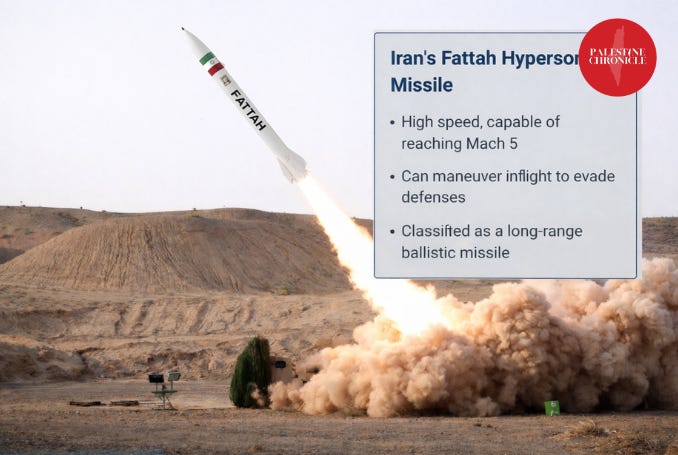
Iran’s reported hypersonic missile use introduces speed and maneuverability that challenge existing regional missile defense systems.
What Is a Hypersonic Missile?
A hypersonic missile is generally defined as a weapon capable of traveling at speeds above Mach 5, or five times the speed of sound.
While many conventional ballistic missiles also reach hypersonic speeds during parts of their trajectory, the defining feature of modern hypersonic systems is not speed alone but how they travel.
Unlike traditional ballistic missiles, which follow a largely predictable arc once launched, hypersonic systems are designed to maneuver during flight. They can adjust direction after launch and may travel at lower altitudes than typical ballistic paths.
This combination of high velocity and in-flight maneuverability complicates detection, tracking, and interception.
Reports that Iran has deployed the Fattah-1 hypersonic missile in recent exchanges suggest a potential qualitative development in the region’s missile dynamics, though independent verification of operational performance remains limited.
Why Does Maneuverability Change the Defensive Equation?
Missile defense systems such as Patriot and THAAD are built around calculating the trajectory of incoming projectiles. If a missile follows a predictable path, interceptors can be launched to collide with it using kinetic force. The effectiveness of these systems depends heavily on reliable tracking and trajectory estimation.
Hypersonic glide vehicles or maneuverable hypersonic missiles introduce uncertainty into that process. Their ability to alter course mid-flight reduces predictability. Lower flight profiles can shorten radar detection windows. Higher speeds compress the time available for defensive decision-making.
The issue is not that interception becomes impossible, but that it becomes more technically demanding and time-sensitive.
What Are the Implications for Air Defense Systems?
Air defense operates on the principles of early detection, sustained tracking, and precise interception timing. Hypersonic systems place pressure on each stage.
If a missile’s trajectory shifts after initial detection, tracking systems must continuously recalculate its path. At very high speeds, even minor timing errors can affect interception probability.
In scenarios involving multiple simultaneous launches or combined use of drones and conventional missiles, defensive systems may also face saturation pressure.
Previous rounds of regional confrontation have shown that even advanced layered defenses do not guarantee complete interception under sustained fire. The introduction of maneuverable hypersonic systems may further test those limits.
What Is the Strategic Significance in the Current War?
The potential impact of hypersonic missiles lies less in isolated strikes and more in cumulative strategic effect. Reduced reaction times, increased tracking complexity, and higher interceptor expenditure can alter cost calculations over the course of a prolonged conflict.
If used repeatedly, such systems could increase the economic and logistical burden on defending states. Interceptors are costly and finite, and replenishment cycles are not instantaneous. In extended confrontations, sustainability becomes as important as performance.
In this sense, hypersonic capability does not automatically determine battlefield outcomes. It does, however, introduce a variable that complicates defensive planning and shifts the technological balance in subtle but meaningful ways.
In Brief
Hypersonic missiles combine very high speed with in-flight maneuverability.
Maneuverability, more than speed alone, complicates interception.
Existing missile defense systems rely on trajectory prediction, which becomes harder when flight paths shift.
Shortened reaction times increase pressure on detection and tracking systems.
Sustained use could raise the economic and logistical burden of missile defense.
The strategic impact depends less on single strikes and more on prolonged deployment.
The key question is whether current defense architectures can adapt over time.
(PC, AJA, IISS, CSIS, US Missile Defense Agency, Congressional Research Service, Reuters)
https://www.youtube.com/watch?v=iH6nN0EUGvM
I come from a multi-generational military family and can tell you, definitively, that the U.S. military has nothing that comes even close to the tech of Iranian hypersonic missiles. The U.S. DOES HAVE ‘dirty’ bombs, like white sulphur, depleted uranium, and bombs that will shred flesh, but nothing that can effectively intercept a sustained attack of Iranian, Chinese, or Russian hypersonic missiles.